
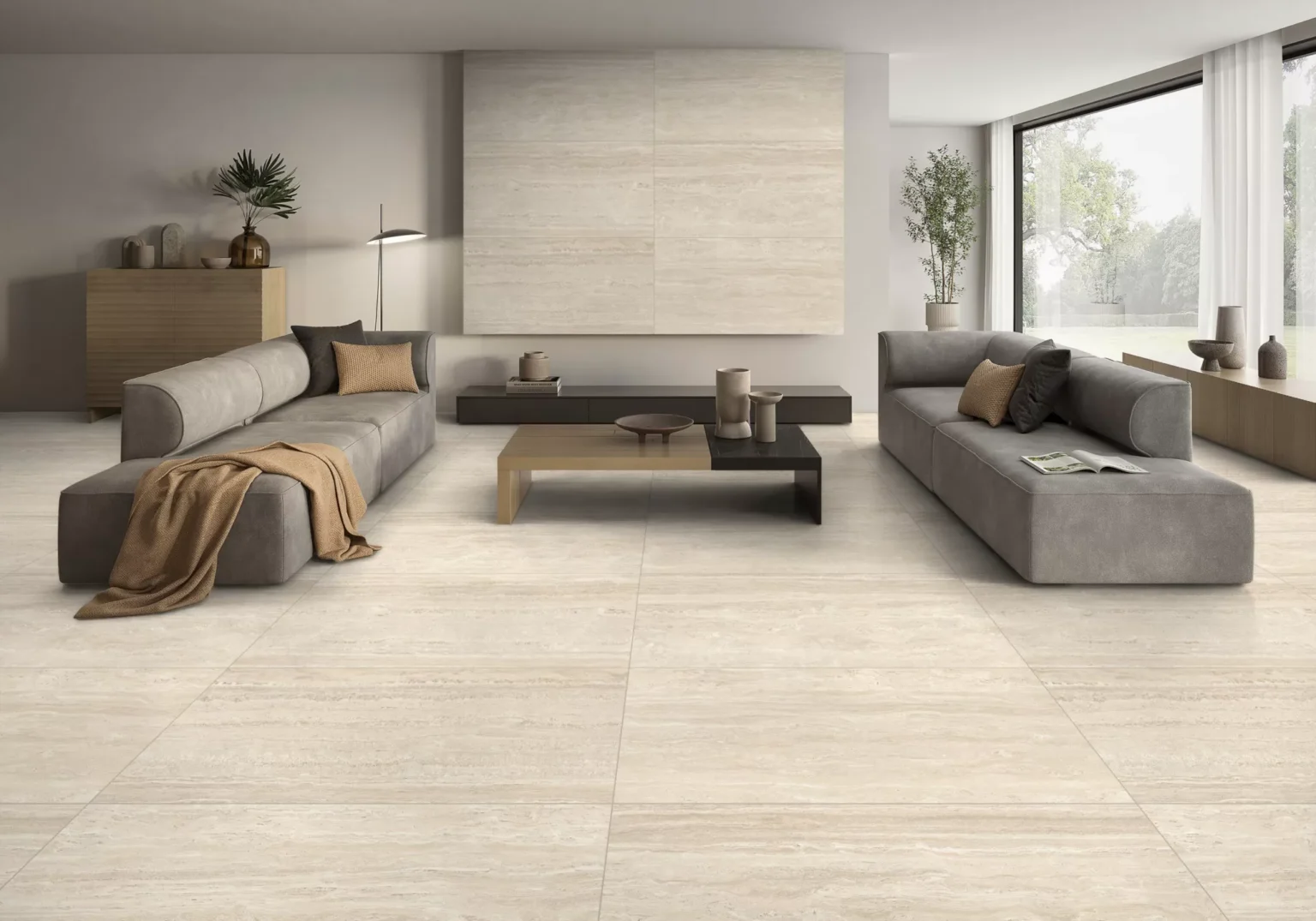
Travertine floor tile is a natural-stone flooring option known for its warm colors, visible pores, soft veining, and timeless appearance. It can give kitchens, bathrooms, entryways, living rooms, patios, and pool areas a distinctive character that manufactured flooring cannot completely reproduce.
However, travertine requires more care than many ceramic or porcelain products. It is porous, sensitive to acidic substances, and naturally variable. Therefore, homeowners must choose the right stone, finish, sealer, installation system, and cleaning products.
This complete guide explains what travertine is, how it forms, where it can be used, which finishes are available, and what to expect from installation and long-term maintenance.
Travertine Floor Tile at a Glance
| Feature | What to know |
| Material | Natural limestone |
| Main composition | Calcium carbonate |
| Common colors | Ivory, beige, cream, gold, walnut, gray, silver, rust, and red |
| Popular finishes | Honed, tumbled, brushed, polished, natural, filled, and unfilled |
| Common cuts | Cross-cut and vein-cut |
| Indoor use | Kitchens, bathrooms, living rooms, bedrooms, and entryways |
| Outdoor use | Patios, walkways, pool areas, and selected exterior installations |
| Water resistance | Porous and not waterproof |
| Sealing | Usually recommended |
| Acid resistance | Poor |
| Scratch resistance | Moderate, depending on finish and use |
| Radiant heating | Often compatible |
| Best cleaner | pH-neutral natural-stone cleaner |
| Expected appearance | Naturally varied rather than perfectly uniform |
What Is Travertine Floor Tile?
Travertine is a type of limestone created by mineral-rich water. It commonly forms near hot springs, mineral springs, and limestone caves where calcium carbonate gradually deposits in layers.
As gases escape during the formation process, they leave small holes, pits, channels, and cavities in the stone. These openings create the texture that makes travertine easy to recognize.
Manufacturers cut large stone blocks into tiles, slabs, pavers, mosaics, and decorative pieces. They may leave the natural holes open or fill them with cement, resin, or another suitable material.
Although some retailers use the phrase “travertine marble,” travertine is not marble. Both are calcium-based natural stones, but they form through different geological processes and have different characteristics.
Where Does Travertine Come From?
Travertine is quarried in several countries. Major sources include:
- Italy
- Turkey
- Mexico
- Spain
- Peru
- China
- Iran
Tivoli, near Rome, is historically associated with Italian travertine. In fact, the word “travertine” developed from terms connected to Tibur, the ancient name for Tivoli.
Turkey is also an important producer, particularly in areas such as Denizli and Afyonkarahisar.
The country of origin alone does not determine quality. Stone density, porosity, consistency, cutting, filling, finish quality, thickness, and quarry selection also affect performance.
What Does Travertine Flooring Look Like?
Travertine generally has a soft, earthy appearance. Unlike some marbles, it usually does not feature sharp, dramatic veins. Instead, it often shows subtle bands, clouds, pores, layered movement, and gradual tonal changes.
Every tile is different. Natural variations may include:
- Light and dark color shifts
- Mineral deposits
- Small or large pores
- Linear bands
- Cloud-like patterns
- Fill variations
- Fossil-like markings
- Natural edge differences
These features are normal characteristics of real stone. However, excessive cracking, weak cavities, severe thickness differences, or poor filling may indicate a quality issue.
Popular Travertine Floor Tile Colors
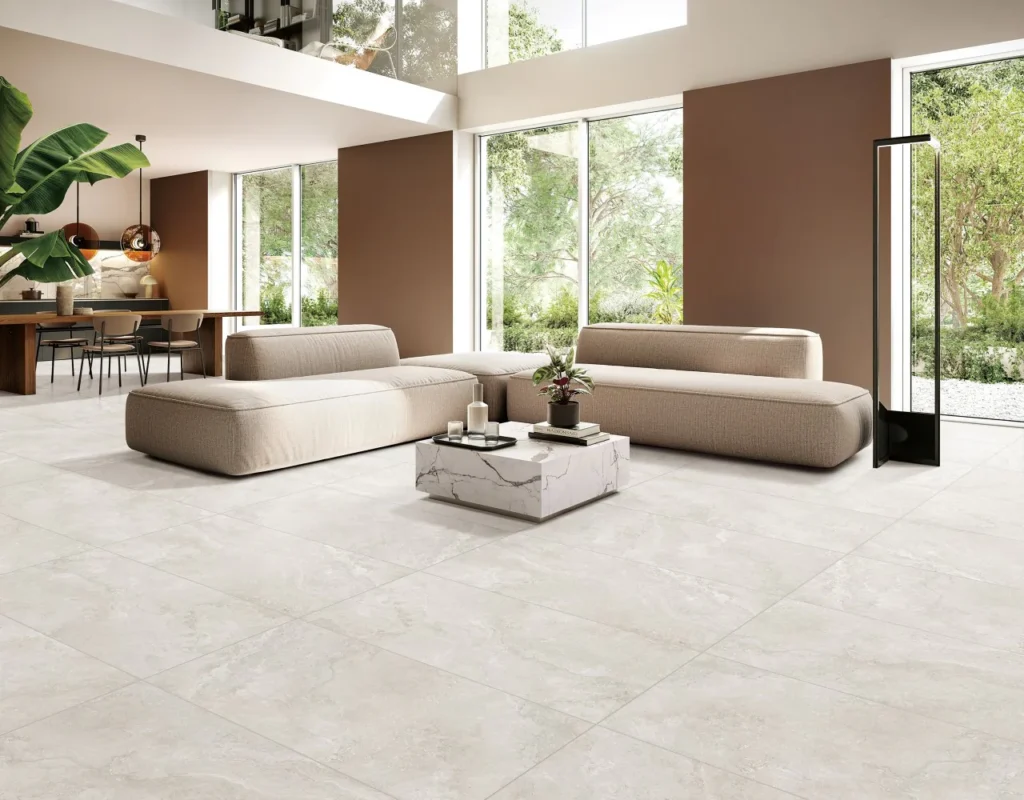
Color has a major effect on the finished room. Because travertine is a natural material, exact shades can vary between quarries and production batches.
Ivory travertine
Ivory travertine is light, warm, and relatively subtle. It works well in bathrooms, kitchens, and living spaces where the goal is to create an open and calm atmosphere.
It pairs effectively with:
- White cabinetry
- Light oak
- Warm metal finishes
- Linen fabrics
- Beige grout
- Soft gray accents
Beige travertine
Beige is one of the most recognizable travertine colors. It may include cream, sand, tan, honey, and pale brown tones.
Beige travertine can complement traditional, transitional, Mediterranean, rustic, and contemporary interiors.
Gold travertine
Gold travertine contains yellow, honey, amber, and warm brown tones. It creates a richer, more decorative appearance than pale beige stone.
It often suits:
- Tuscan-style interiors
- Traditional kitchens
- Warm wood cabinets
- Bronze hardware
- Mediterranean-inspired rooms
Walnut travertine
Walnut travertine includes deeper brown, tan, and caramel tones. It can make a large room feel warmer and more grounded.
However, darker floors may show pale dust, mineral residue, or scratches more clearly than some mid-tone surfaces.
Silver and gray travertine
Gray or silver travertine offers a cooler and more contemporary appearance. Depending on the stone, it may contain beige, blue-gray, brown, or charcoal movement.
It pairs well with:
- Black metal
- Concrete
- Pale wood
- White walls
- Minimalist furnishings
- Industrial-style details
Red and rust travertine
Red travertine may contain rust, terracotta, brick, burgundy, and brown mineral tones. It creates a strong visual statement and often works well in Mediterranean or rustic designs.
Because it has more noticeable color variation, homeowners should review several samples before ordering.
Travertine Floor Tile Finishes
The finish affects appearance, texture, maintenance, traction, and suitability for different locations.
Honed travertine floor tile
Honed travertine has a smooth, matte or satin-like surface. Manufacturers grind the stone to create an even texture without a strong reflective shine.
Honed travertine is popular for indoor flooring because it offers a refined appearance while preserving the stone’s natural color and texture.
Benefits include:
- Smooth appearance
- Less shine than polished stone
- Suitable for many interior styles
- Often easier to live with than highly polished surfaces
However, honed does not automatically mean slip-resistant. Product-specific testing and the complete installation still matter.
Tumbled travertine
Tumbled travertine has worn-looking edges and a textured, aged surface. The tumbling process creates a rustic appearance that can make new flooring look established and natural.
It is commonly used in:
- Mediterranean interiors
- Rustic kitchens
- Patios
- Garden paths
- Pool areas
- Informal entryways
The surface may offer more texture than polished stone, but pits and uneven areas can trap dirt if they are not maintained correctly.
Brushed travertine
Brushed travertine is mechanically textured with brushes. It usually feels more tactile than honed stone but less aged than deeply tumbled material.
Brushed finishes may suit contemporary rustic, transitional, and outdoor designs.
Polished travertine
Polished travertine has a glossy and reflective finish. Polishing deepens the stone’s color and makes its bands and mineral patterns more noticeable.
However, polished travertine may:
- Become slippery when wet
- Show etching more clearly
- Reveal scratches and wear
- Require more careful maintenance
For these reasons, polished stone requires particular caution in bathrooms, entrances, kitchens, and other moisture-prone spaces.
Natural or rough-cut travertine
Natural or rough-cut travertine preserves more of the original stone texture. It may be selected for outdoor installations, walls, architectural features, and rustic spaces.
Nevertheless, a rough surface does not automatically mean the product is safe for wet floors. Always request application and slip-performance information.
Filled vs. Unfilled Travertine
The holes in travertine may remain open or receive a filler before finishing.
Filled travertine floor tile
Filled travertine has a smoother surface because manufacturers fill the stone’s natural cavities.
Common filler materials include:
- Cement-based compounds
- Resin
- Color-matched stone filler
- Grout-like products
Filled stone is usually easier to sweep and mop because fewer open spaces collect dirt.
It often works well in:
- Kitchens
- Living rooms
- Bedrooms
- Entryways
- Interior hallways
However, filler may crack, loosen, discolor, or wear over time. Small repairs may become necessary, especially in high-traffic areas.
Unfilled travertine
Unfilled travertine keeps its natural holes visible. It creates a more textured, rustic appearance.
Although visually attractive, open cavities may collect:
- Dirt
- Dust
- Water
- Food particles
- Soap residue
- Outdoor debris
Installers sometimes fill the holes during grouting. The final appearance depends on grout color, installation method, and the depth of the openings.
Unfilled travertine is not automatically more suitable for exterior use. Open voids may retain moisture, which can cause problems in freezing climates.
Cross-Cut vs. Vein-Cut Travertine
The cutting direction changes the stone’s pattern.
Cross-cut travertine
Cross-cut travertine is sliced across the natural bedding layers. It usually displays circular, cloudy, mottled, or swirling patterns.
Cross-cut stone creates a softer and less directional appearance. It works well in:
- Traditional homes
- Rustic spaces
- Bathrooms
- Mediterranean interiors
- Large open floors
Vein-cut travertine
Vein-cut travertine is sliced parallel to the bedding layers. It reveals long, linear bands that can resemble wood grain.
Vein-cut tile can create a more architectural and contemporary look.
The installer may arrange the lines:
- In one continuous direction
- In alternating directions
- In a book-matched style
- As a border
- In a geometric pattern
Because the direction strongly affects the finished appearance, dry-laying vein-cut tiles is especially important.
Common Travertine Tile Sizes and Formats
Travertine comes in many formats, including:
- Small square mosaics
- Rectangular mosaics
- Standard square tiles
- Large square tiles
- Plank-style tiles
- Modular sets
- Pebble mosaics
- Waterjet patterns
- Borders
- Medallions
- Exterior pavers
Not every travertine product is appropriate for flooring. Some mosaics are designed only for walls or backsplashes.
In addition, online collections sometimes include porcelain, ceramic, glass, marble, or mixed-material products under a travertine category. Therefore, always confirm the actual material.
Popular Travertine Floor Patterns
The installation pattern can make a simple neutral stone look traditional, contemporary, or highly decorative.
Straight lay
A straight lay arranges the tiles in a regular grid.
It creates:
- Clean grout lines
- A calm appearance
- Easy furniture alignment
- A simple installation plan
Straight layouts work well with square and large-format tiles.
Staggered or brick pattern
A staggered pattern offsets each row. It creates more movement than a straight grid.
Before choosing a large offset, check tile flatness and manufacturer recommendations. Some rectangular tiles may not remain perfectly flat across their entire length.
Herringbone pattern
Herringbone uses rectangular pieces arranged in a zigzag design.
It can add visual interest to:
- Entryways
- Hallways
- Powder rooms
- Feature zones
- Kitchen floors
Because the layout involves more cuts and alignment, installation may cost more than a standard grid.
French or Versailles pattern
A French pattern combines several tile sizes in a repeating modular design.
It is popular in:
- Mediterranean homes
- Large kitchens
- Patios
- Traditional living areas
- Indoor-outdoor spaces
Suppliers may use “French pattern” and “Versailles pattern” interchangeably. However, module dimensions may differ, so buyers should confirm every included size.
Running bond
Running bond resembles a traditional brick layout and works well with rectangular stone.
It can make a floor feel informal and continuous.
Border and field design
A border surrounds a central field of tile. It can define:
- Dining areas
- Entryways
- Kitchen zones
- Bathroom floors
- Hallways
Borders may use a darker travertine, marble, glass, or another stone. However, every material must be suitable for the same installation location.
Advantages of Travertine Flooring
Travertine offers several practical and visual benefits.
Natural beauty
Every travertine tile has its own pores, mineral marks, bands, and tonal shifts. Therefore, the floor does not look mechanically repeated.
Timeless appearance
Travertine has been used in architecture for centuries. Its neutral colors can work with changing furniture, paint, and décor trends.
Design versatility
Travertine suits many interior styles, including:
- Traditional
- Rustic
- Mediterranean
- Transitional
- Contemporary
- Minimalist
- Spa-inspired
- Coastal
Long service life
Properly selected and installed travertine can last for decades.
However, long service life depends on:
- Stone quality
- Substrate preparation
- Mortar coverage
- Movement joints
- Moisture control
- Cleaning practices
- Sealing
- Traffic
- Climate
Radiant-heating compatibility
Travertine conducts and stores heat effectively. As a result, it often works well over compatible radiant-floor heating systems.
Without heating, stone may feel cool underfoot. With a suitable system, it can provide steady and comfortable warmth.
Repair potential
In some cases, professionals can repair small pits, replace filler, refinish worn areas, or replace individual tiles.
Keeping extra tiles from the original batch makes future repairs easier.
Indoor and outdoor visual continuity
Matching or complementary travertine products can connect interior rooms with patios or pool areas.
However, interior tile and exterior pavers are not automatically interchangeable. Exterior materials may require different thicknesses, finishes, absorption levels, and installation methods.
Disadvantages of Travertine Flooring
Travertine is attractive, but it is not the easiest flooring material to own.
Porosity
Travertine can absorb:
- Water
- Oil
- Coffee
- Wine
- Cosmetics
- Food
- Cleaning chemicals
A compatible sealer reduces absorption, but it does not create a waterproof or stain-proof surface.
Acid sensitivity
Travertine reacts to acids because it contains calcium carbonate.
Acidic substances may cause etching, including:
- Vinegar
- Lemon juice
- Citrus cleaners
- Wine
- Tomato sauce
- Some bathroom cleaners
- Descaling chemicals
Etching usually appears as a dull, pale, or rough area. It is a chemical change in the stone rather than ordinary dirt.
Scratches and chips
Tracked-in grit can act like sandpaper. Furniture movement, dropped objects, poor installation, or weak natural cavities may cause scratches and chips.
Maintenance requirements
Travertine requires more careful cleaning than many porcelain or vinyl floors.
Owners may need to:
- Use special cleaners
- Wipe spills quickly
- Reseal periodically
- Repair loose filler
- Avoid acidic products
- Protect the floor from grit
Natural variation
A small showroom sample cannot show the full range of a large order.
Some homeowners love strong variation. Others may find it unpredictable.
Installation difficulty
Travertine is heavy and naturally variable. Installation may require professional skill, especially for large tiles, mosaics, wet areas, modular patterns, and exteriors.
Cold and hard surface
Travertine may feel cold without radiant heating. It is also hard underfoot and does not cushion dropped objects.
Potential slipperiness
A wet travertine floor may become slippery, particularly when polished.
Finish names alone do not prove slip resistance. Tile size, grout-joint frequency, contaminants, footwear, slope, drainage, and tested performance all matter.
Where Can Travertine Floor Tile Be Used?
Kitchen floors
Travertine can create a warm and elegant kitchen floor. However, kitchens expose stone to oil, food, citrus, wine, coffee, and dropped cookware.
A kitchen installation should include:
- Suitable sealing
- Prompt spill cleanup
- Entry or sink mats
- Furniture protection
- Stone-safe cleaning products
People who want a perfectly uniform and stain-resistant floor may prefer travertine-look porcelain.
Bathroom floors
Travertine can work in bathrooms when the exact product and installation system suit wet conditions.
Important factors include:
- Waterproofing
- Drainage
- Slip performance
- Tile size
- Grout joints
- Sealer compatibility
- Ventilation
- Cleaning routine
Travertine and sealer are not the waterproofing system. Waterproofing must exist beneath or behind the tile assembly.
Shower floors
Small travertine mosaics may create more grout joints, which can improve foot contact. Nevertheless, more grout does not automatically make a shower floor safe.
Before using travertine in a shower, verify:
- Floor rating
- Wet-area approval
- Slip testing
- Drainage
- Waterproofing
- Slope
- Cleaning requirements
- Sealer suitability
Living rooms
Travertine works particularly well in large living spaces, warm climates, open-plan homes, and rooms with radiant heating.
Its natural colors complement wood, plaster, brick, leather, linen, and metal.
Entryways
Travertine can handle regular residential traffic, but entry mats are important. They reduce grit, moisture, mud, and deicing residue.
Bedrooms
Travertine can create a clean and upscale bedroom, especially in warm climates.
However, some people may find it too cold or hard without rugs or radiant heating.
Patios
Exterior-rated travertine may work on patios when the installation provides proper drainage, movement accommodation, and climate resistance.
Interior travertine tile should not automatically be used outside.
Pool decks
Tumbled or textured travertine is often considered for pool areas because of its natural appearance and relatively cool feel.
However, buyers must verify:
- Wet slip performance
- Pool-chemical compatibility
- Salt exposure
- Drainage
- Thickness
- Climate suitability
- Freeze-thaw rating
Commercial spaces
Some travertine products may suit hotels, restaurants, offices, and retail areas.
Commercial use requires product-specific information about:
- Traffic
- Wear
- Breaking strength
- Slip performance
- Cleaning
- Maintenance
- Thickness
- Installation system
A seller’s commercial-use claim should be supported by technical documentation.
Can Travertine Floor Tile Be Used Outdoors?
Some travertine products can be used outdoors, but not every travertine tile is exterior-rated.
Exterior performance depends on:
- Water absorption
- Density
- Pore structure
- Thickness
- Stone quality
- Finish
- Drainage
- Mortar and grout
- Climate
- Freeze-thaw cycles
- Deicing salts
- Installation method
Water can enter pores and cavities. When that water freezes, it expands and may damage unsuitable stone or installations.
Therefore, homeowners in cold climates should request written confirmation that the exact product is suitable for repeated freezing and thawing.
Travertine Tile vs. Travertine Pavers
Travertine tile and travertine pavers are not necessarily the same product.
| Feature | Travertine tile | Travertine paver |
| Typical location | Interior floors and walls | Patios, walkways, and pool areas |
| Thickness | Usually thinner | Usually thicker |
| Installation | Often installed with mortar | May use mortar or other approved exterior systems |
| Finish | Honed, polished, filled, or tumbled | Commonly tumbled or textured |
| Climate rating | Product-specific | Still product-specific |
| Interchangeable | Not automatically | Not automatically |
Never assume a thin interior tile can replace an exterior paver.
Is Travertine Floor Tile Slippery?
Travertine can become slippery, especially when wet, polished, contaminated, or poorly drained.
Factors affecting traction include:
- Finish
- Surface texture
- Tile size
- Grout-joint density
- Water
- Soap residue
- Oil
- Pool chemicals
- Footwear
- Slope
- Maintenance
Honed or tumbled surfaces may offer more texture than polished stone. Still, the only dependable approach is to request product-specific slip-test information for the intended environment.
Does Travertine Need to Be Sealed?
Most porous travertine installations benefit from a compatible penetrating sealer.
A sealer may:
- Slow liquid absorption
- Improve stain resistance
- Make spills easier to clean
- Protect grout and filler
- Reduce deep contamination
However, sealing does not make travertine:
- Waterproof
- Acid-proof
- Stain-proof
- Scratch-proof
- Maintenance-free
- Slip-resistant
The best sealer depends on the stone, finish, location, grout, filler, and desired appearance.
Some sealers preserve the natural color, while enhancing sealers deepen or darken it. Always test the product on a spare tile or hidden area first.
How Often Should Travertine Be Resealed?
There is no universal resealing schedule.
The frequency depends on:
- Stone porosity
- Existing sealer
- Traffic
- Moisture exposure
- Cleaning products
- Outdoor weather
- Finish
- Spill frequency
- Manufacturer instructions
A heavily used kitchen may need attention sooner than a low-traffic bedroom.
Avoid automatically resealing on a calendar without evaluating the surface. Excess product can create haze, uneven appearance, or residue.
How to Clean Travertine Floor Tile
Remove loose dirt regularly
Sweep, dust mop, or vacuum the floor to remove grit. Use a vacuum head that will not scratch the stone.
Use a pH-neutral cleaner
Clean with a pH-neutral product specifically approved for natural stone.
Follow the manufacturer’s dilution instructions. Using too much cleaner may leave residue.
Wipe spills immediately
Blot rather than spread spills.
Pay particular attention to:
- Lemon juice
- Vinegar
- Wine
- Coffee
- Cooking oil
- Tomato sauce
- Makeup
- Toiletries
- Pet accidents
Dry wet areas
Drying the surface reduces water spots, soap residue, and mineral deposits.
Protect high-traffic areas
Use:
- Entry mats
- Stone-safe rug pads
- Furniture pads
- Protective mats near sinks
- Regular dust removal
Make sure rug pads do not contain chemicals that can discolor natural stone.
What Should You Not Use on Travertine?
Avoid products that contain or act like acids.
Do not use:
- Vinegar
- Lemon cleaners
- Acidic bathroom cleaners
- Unapproved descalers
- Abrasive powder
- Steel wool
- Rough scouring pads
- Unknown multipurpose cleaners
- Wax not intended for stone
- Strong chemicals without manufacturer approval
For disinfecting, use only a product approved by the stone, grout, filler, and sealer manufacturers.
Common Travertine Problems and Repairs
Etching
Etching creates dull or rough areas after acid contact.
Minor etching may respond to professional polishing or refinishing. Severe damage may require a stone-restoration specialist.
Stains
Stains may penetrate below the surface.
Depending on the substance, a professional may use a suitable stone poultice. Random household chemicals can make the problem worse.
Loose filler
Filled cavities may loosen or crack.
Installers or stone professionals can often clean the opening and apply compatible repair material.
Chips
Small chips may be repaired with color-matched stone filler or resin.
Large or visually prominent damage may require tile replacement.
Cracked tiles
Cracks may result from impact, substrate movement, poor mortar coverage, missing movement joints, or structural problems.
Replacing the tile without fixing the underlying cause may lead to another crack.
Uneven tiles
Height differences between adjacent tiles are often called lippage.
Proper substrate preparation, tile selection, mortar coverage, and installation technique help reduce the problem.
Haze after installation
Grout, sealer, or construction residue may leave a cloudy film.
Use only a removal method approved for calcium-based natural stone. Acidic grout-haze removers can damage travertine.
Travertine Floor Tile Installation
Professional installation is often a wise choice because natural stone requires careful preparation.
Inspect the shipment
Before installation, check:
- Material type
- Color range
- Thickness
- Size
- Finish
- Damage
- Fill quality
- Quantity
- Lot consistency
Do not install unacceptable material. Installation is commonly treated as acceptance.
Dry-lay the stone
Lay out several tiles before setting them.
This allows the installer to:
- Blend color variation
- Control vein direction
- Distribute dark and light pieces
- Plan cuts
- Avoid unwanted clusters
- Confirm the pattern
Prepare the substrate
The substrate must be:
- Stable
- Flat
- Clean
- Dry enough for the installation system
- Structurally suitable
- Free from contaminants
Stone and tile do not correct an unstable floor.
Use compatible mortar
Use a mortar approved for:
- Natural stone
- The substrate
- Tile size
- Interior or exterior conditions
- Wet or dry locations
- Radiant heating, when present
Light-colored mortar may be preferable beneath pale or translucent stone.
Achieve proper mortar coverage
Voids beneath the tile can increase the risk of cracking, especially with natural stone and exterior installations.
Follow applicable standards and setting-material instructions.
Plan movement joints
Buildings and tile assemblies expand, contract, and move.
Movement accommodation is essential around:
- Room edges
- Large floor areas
- Doorways
- Structural joints
- Changes in substrate
- Sun-exposed areas
- Radiant-heated floors
Grout should not replace required movement joints.
Choose grout carefully
Grout color can strongly affect the appearance of open pores and joints.
A contrasting grout may highlight the pattern, while a matching grout creates a quieter surface.
Confirm that the grout is suitable for natural stone and will not scratch the finish.
Seal at the correct stage
Some installers seal travertine before grouting to reduce staining or simplify cleanup. Others follow a different sequence based on the stone, grout, and sealer.
Always follow the complete installation-system instructions.
Is Travertine Floor Tile Good for DIY Installation?
A simple, small, dry-room project may be possible for an experienced DIYer. Nevertheless, travertine is generally more difficult than basic ceramic tile.
DIY risks include:
- Broken tiles
- Poor cuts
- Uneven surfaces
- Inadequate mortar coverage
- Staining
- Incorrect sealing
- Grout haze
- Unplanned variation
- Missing movement joints
- Water damage in wet areas
Professional installation is strongly recommended for:
- Showers
- Bathrooms
- Exterior areas
- Pool decks
- Large-format stone
- French patterns
- Heated floors
- Commercial spaces
- Uneven substrates
What Affects Travertine Floor Tile Cost?
Travertine prices vary widely. Therefore, a single price range may be misleading without knowing the product, region, and project.
Material cost depends on:
- Quarry and country of origin
- Stone grade
- Color
- Rarity
- Tile size
- Thickness
- Finish
- Cut direction
- Filled or unfilled surface
- Calibration
- Edge treatment
- Freight and import costs
- Order quantity
Installation cost depends on:
- Subfloor condition
- Removal of old flooring
- Waterproofing
- Pattern complexity
- Tile size
- Number of cuts
- Stairs
- Floor leveling
- Radiant heating
- Sealing
- Grout choice
- Local labor rates
Long-term cost may include:
- Stone-safe cleaners
- Resealing
- Filler repair
- Professional refinishing
- Replacement tiles
- Grout maintenance
Request an estimate that separates material, preparation, installation, sealing, and finishing.
How Much Extra Travertine Should You Order?
Extra material covers cuts, breakage, pattern matching, sorting, and future repairs.
The amount depends on:
- Room shape
- Installation pattern
- Tile size
- Color variation
- Vein direction
- Number of corners
- Expected breakage
Complex patterns and highly variable stone usually require more overage than a simple straight layout.
Keep several unused tiles from the original batch. A future batch may not match the color or veining.
How to Choose High-Quality Travertine
When comparing products, examine:
Pore size and distribution
Large or extensive cavities may require more filling and may affect strength or appearance.
Fill quality
Check whether the filler is smooth, firmly bonded, and close to the stone’s color.
Thickness consistency
Consistent thickness simplifies installation and reduces unevenness.
Edge quality
Edges should match the intended finish. Chipped or poorly cut edges may create installation problems.
Surface finish
Look for inconsistent polishing, scratches, factory residue, or patchy texture.
Color range
Review several pieces instead of relying on one sample.
Cracks
Natural lines are common, but structural cracks or weak pieces require careful evaluation.
Product documentation
Ask for:
- Material composition
- Intended use
- Thickness
- Coverage
- Finish
- Slip information
- Exterior approval
- Freeze-thaw suitability
- Care instructions
- Warranty
- Return policy
Travertine vs. Travertine-Look Porcelain Tile
Many homeowners like the appearance of travertine but prefer easier maintenance. Travertine-look porcelain may be a practical alternative.
| Feature | Natural travertine | Travertine-look porcelain |
| Material | Natural limestone | Manufactured ceramic product |
| Pattern | Naturally unique | Printed or digitally reproduced |
| Porosity | Usually porous | Usually much less absorbent |
| Sealing | Commonly required | Usually not required for the tile body |
| Acid sensitivity | Can etch | Generally more resistant |
| Maintenance | Requires stone-safe care | Usually easier |
| Variation | Unpredictable and natural | More controlled |
| Refinishing | Sometimes possible | Usually replaced rather than refinished |
| Weight | Often heavy | Product-specific |
| Exterior use | Requires exact approval | Also requires exact approval |
| Authenticity | Genuine natural stone | Stone-look surface |
Choose natural travertine when authentic variation and natural texture matter most.
Choose porcelain when easier cleaning, lower porosity, and more predictable performance are priorities.
Travertine vs. Marble
Travertine and marble are both natural calcium-based stones, but they are not the same.
Travertine usually has:
- Visible pores
- Softer tonal variation
- Layered bands
- A more rustic appearance
Marble often has:
- Denser-looking surfaces
- More dramatic veining
- A smoother polished appearance
- Different crystalline structure
Both can etch when exposed to acid.
Travertine vs. Limestone
Travertine is a type of limestone.
However, conventional limestone may have a denser, more uniform appearance and fewer open pores. Performance varies greatly between individual stones, so the stone name alone does not determine suitability.
Travertine vs. Ceramic Tile
Ceramic tile is manufactured from clay and fired in a kiln.
Compared with travertine, ceramic tile often offers:
- Lower material cost
- Easier maintenance
- Greater pattern consistency
- Less need for sealing
Travertine offers:
- Natural variation
- Authentic stone texture
- Potential refinishing
- A more organic appearance
Is Travertine Flooring Environmentally Friendly?
Travertine is a natural material that may last for decades. It can also sometimes be repaired or refinished rather than immediately replaced.
However, calling it automatically eco-friendly would be misleading.
Environmental impact depends on:
- Quarrying methods
- Fabrication
- Water and energy use
- Transportation distance
- Packaging
- Installation materials
- Service life
- Maintenance
- Repairability
- End-of-life reuse or disposal
A product-specific life-cycle assessment provides stronger evidence than a general natural-versus-synthetic comparison.
Is Travertine Good for Allergy-Sensitive Homes?
A hard floor does not trap dust and pet hair in the same way that carpet fibers can. It may therefore be easier to sweep and mop.
However, travertine should not be described as allergen-proof.
Indoor conditions also depend on:
- Cleaning frequency
- Grout condition
- Moisture control
- Sealers
- Adhesives
- Ventilation
- Mold prevention
- Household habits
Best Design Pairings for Travertine Floors
Travertine pairs well with many materials.
Wood
Warm wood enhances beige, walnut, and gold travertine.
White cabinetry
White cabinets create contrast and keep beige stone from making a room feel too dark.
Black metal
Black fixtures and frames add a contemporary edge to silver or beige travertine.
Glass accents
Glass mosaics can add shine beside matte stone. However, confirm whether the glass product is floor-rated or intended only for walls.
Terracotta
Terracotta complements warm red, rust, and gold stone.
Natural fabrics
Linen, wool, cotton, and woven materials reinforce travertine’s organic appearance.
Painted walls
Good wall colors include:
- Warm white
- Cream
- Greige
- Soft taupe
- Pale gray
- Muted green
- Earthy clay tones
Always evaluate samples in the room’s actual lighting.
Travertine Floor Tile Buying Checklist
Before ordering, confirm the following:
- Is the product genuine travertine?
- Is it approved for flooring?
- Is it suitable for the intended room?
- Can it be used in wet areas?
- Is it approved for exterior use?
- Is it freeze-thaw rated where necessary?
- Is it filled or unfilled?
- Is it cross-cut or vein-cut?
- What is the finish?
- What is the tile thickness?
- What area does each box cover?
- Is the price per tile, sheet, box, or square foot?
- What variation should you expect?
- Can you see current batch photographs?
- Is slip-test information available?
- What mortar and grout are recommended?
- Does it require sealing?
- What is the return policy?
- How quickly must damage be reported?
- Are samples or custom orders returnable?
- How much extra material should you order?
Is Travertine Floor Tile Worth It?
Travertine floor tile is worth considering when you want:
- Genuine natural stone
- Warm and neutral coloring
- Unique tile-to-tile variation
- A surface that can develop character
- Compatibility with radiant heating
- A traditional or timeless appearance
It may not be the best choice when you want:
- A perfectly uniform floor
- Minimal maintenance
- High acid resistance
- No sealing
- Predictable pattern repetition
- A completely stain-proof surface
- An easy beginner DIY project
The best results come from realistic expectations. Travertine is not flawless, but its pores, tonal shifts, and natural movement are exactly what many homeowners find attractive.
Frequently Asked Questions About Travertine Floor Tile
Travertine is a natural form of limestone made primarily from calcium carbonate. It develops through mineral deposition around springs and caves.
Yes, properly selected and installed travertine can last for many years. However, it can still scratch, chip, stain, etch, or wear.
Most porous travertine floors benefit from a compatible penetrating sealer. Sealing slows absorption but does not make the stone waterproof or acid-proof.
No. Travertine is porous. Bathrooms, showers, and other wet spaces require a complete waterproofing system beneath or behind the tile.
Yes. However, homeowners must wipe up oil, wine, coffee, tomato sauce, vinegar, and citrus quickly.
Yes, when the exact tile, finish, waterproofing, drainage, grout, and sealer are suitable for the location.
Some small-format travertine mosaics may work on shower floors. Product-specific wet-use and slip information is essential.
It can be. Polished surfaces may present greater risk. Nevertheless, finish name alone does not establish traction.
Some travertine products can be used outside. Verify freeze-thaw performance, absorption, thickness, drainage, slip performance, and climate suitability.
Exterior-rated textured travertine may suit pool areas, but the exact product must withstand wet conditions, pool chemicals, climate, and the chosen installation method.
Yes, travertine commonly works with compatible radiant-heating systems because it conducts and stores heat.
No. Vinegar is acidic and can etch the stone.
Use a pH-neutral cleaner specifically formulated for natural stone.
There is no fixed schedule. Resealing depends on the stone, traffic, moisture, existing sealer, and manufacturer instructions.
Filled travertine has smoother cavities that contain resin, cement, or another filler. Unfilled travertine keeps its natural holes visible.
Honed travertine is smooth and matte. Tumbled travertine has softened edges and a more aged, textured appearance.
No. Travertine is a form of limestone, although some retailers use the inaccurate trade phrase “travertine marble.”
Porcelain is usually less porous and easier to maintain. Travertine offers authentic natural variation. The better choice depends on appearance, maintenance expectations, and installation conditions.
A well-designed natural-stone floor may appeal to buyers, but it does not guarantee a specific increase in property value. Condition, installation quality, local preferences, and overall home design all matter.
Professionals can often repair small chips, loose filler, stains, and etching. Structural cracks may require substrate correction and tile replacement.
Professional installation is advisable for wet areas, exteriors, modular patterns, large tiles, radiant-heated floors, and uneven substrates.
Final Thoughts
Travertine floor tile offers natural beauty, warm colors, distinctive pores, and a long architectural history. It can create elegant kitchen floors, spa-inspired bathrooms, welcoming entryways, comfortable living spaces, and visually connected patios.
Nevertheless, travertine requires informed planning. The stone is porous, sensitive to acids, naturally variable, and dependent on correct installation. Sealer improves stain resistance but does not make it waterproof. Similarly, a textured finish does not automatically guarantee safe wet-area performance.
Before buying, verify the material, application rating, finish, fill, thickness, color range, slip information, exterior suitability, installation requirements, and maintenance instructions.
With the right product, qualified installation, pH-neutral cleaning, prompt spill care, and appropriate sealing, a travertine floor can remain attractive and functional for many years.